Advanced Practice Proposal:
Interactive Frag Rap

Introduction
My performance project will be using interactive instrument made up of iconic Ad-lib one shots, to inspire evolvement in the manner of which vocals are overdubbed.
Inspiration
SZA’s sophomore album ‘SOS’ contains the track ‘Low’ (SZA, 2022) Which has inspired the direction I am taking for my advance practice performance.
This track is especially unique due to its explicit use of ad libs from performer ‘Travis Scott’ even though he himself doesn’t make an appearance himself. Whilst SZA is very capable of delivering Ad libs, the use of Travis’s signature vocals are used to imply that the nature of the track is to be wild. This is because the signature vocals of the post-modern rapper have become synonymous with the ‘rage’ culture that has been on a prominent rise throughout the last decade, and therefore the use of these vocal one shot are used to enforce the overall tone of the track to better suit that sub-genre of music.
Which begs the question, is this only useful as a one-off feature, or can it be replicated effectively across a plethora of tracks and instrumentals to reinforce a desired reaction from listeners?
In the past decade, the linguistic nature of vocal performances has transformed significantly in emerging sub-genre’s such as drill and trap music, progressively changing the way vocals are recorded and over-dubbed within studio environments. Whilst prominent ‘Frag Rappers’ may overdub another vocal onto a separate track after recording and processing their verse, it’s worth exploring whether the presence of the artist is entirely necessary when many vocalists have iconic one-shot vocals that are synonymous with their branding and the style of music they make, and knowing that we have the tools and control to playback vocal samples on MIDI controllers to build an overdub with greater care for the rhythm based content that they can provide.
Background Research
My research towards this project has been surrounding the fundamental nature of how vocal performances have continued to evolve since the advent of various vocal processing tools. More specifically, Kit Mackintosh's “Neon Screams” (Mackintosh, 2021) has been a pivotal piece of literature that has done a great job of illustration the landscape of western music post 2010 and has influenced me to take this direction towards my performance project. “Neon Screams” explores the hysterical nature of vocal delivery from hip hop musicians since the birth of auto-tune, and how “the streets” have come to embrace more distortional performance value compared to the urban contemporary music that graced the public during the late 20th century and early 2000’s. The book goes into deep detail about the linguistically challenging likes of Future, Vybz Kartel, Playboi Carti, and how artists like these are becoming dictators with regards the nature of Hip-Hop’s new emerging sub-genre’s, such as UK/Brooklyn drill, trap and bashment.
The likes of Future and Young Thug are very known for their unintelligible delivery of their lyrical content. They are also willing to concede that this apparent mis-delivery of performance is an essential aspect. While many artists perform using clear vocabulary when delivering their ad-libs, they tend to lean towards giving their ad-libs unintelligible edge, with the assistance of the vocal production tools that can further this effect. Many examples of this slurred indistinguishable delivery can be heard on their collaborative project ‘Super Slimey’ (Future & Young Thug, 2017) where they merge these signature sounds together, sounds of which also have been so definitive of a plethora of their solo projects.
“Neon Screams” also has a chapter specifically dedicated to “Frag Rap”, going in length to emphasise its purposeful use for rhythmic value and using individual syllables to break in gaps between the vocal and the song structure, as well as how this is often done on beat as if it were an additional piece of instrumentation. With Ad-libs becoming more associated with the process of post-composition in mind, it seems that exploring the utilisation of drum machines to apply live vocal overdubs may be an avenue worth going down for producers and engineers alike for the progression of overdubbing techniques for the foreseeable future.
Playboi Carti is a perfect personification that emphasises the compositional value that can is attainable through the act of ‘Frag Rap’. On his punk-rap inspired track ‘Stop Breathing’ (Playboi Carti, 2020), he delivers a performance of vocal over-dubs that thoroughly demonstrates the percussive compositional value that his ad-libs can have. Even in sections of the song where lyrical content is absent, the rhythmic content provided by Jordan ‘Carti’ Carter’s ad-lib performance does a constant job of keeping the listener engaged throughout the track, with many unique sounds.
Having been born in the very late 90’s, I have been living through the drastic changes of Hip Hop’s vocal cadence that is described within the reading and spent much of the listening time of my adolescence and beyond indulging in the daring endeavours that artist make to change in the performance values that are now dictating the top of the music scene. The likes of Migos, Baby Keem and Travis Scott, have been heavy influences in my ever-evolving understanding of the purpose of Ad-libs in a post-modern music scene, where the original rules that defined Hip Hop have been broken to make way for genre’s that are harder to recognise for those who are unfamiliar to these names and more accustomed to the older stereotypes that used to define the urban contemporary scene.
Migos became global superstars when they brought Atlanta’s trap music sound to the world with their debut album ‘Culture’ (Migos, 2017). Thanks to the viral success of ‘Bad and Boujee’, (Migos, 2016) the trio’s first studio album was held to much critical acclaim. It was Offset’s performance on the hook of this song, along with the ad-libs accompanying it, that made the song such a breakthrough success. The signature vocal one shot appearing during the hook, encouraged an audience reciprocation of the catchy Atlanta rapper style that was long overdue a global breakthrough, as the YRN rappers eventually broke the barrier to make Atlanta rap a mainstream commodity.
Veteran Atlanta based performers such as “Gucci Mane” have been recorded during their ad-lib overdubs, and there are videos of him doing so which demonstrate the simplicity of the current industry standard method of applying additional vocal tracks (Blindfolksvision1, 2018).
Gucci Mane himself was on his professional come up during the late 0’s and has been active during the large portion of hip-hops gradual change in direction from the typical linguistic styles heard on traditional rap tracks where ad-libs were more absent. With Atlanta’s rapid rise in the hip hop scene that followed his debut projects, ad-lib rapping has become far more conventional compared to the days Gucci Mane was starting his career in, hence why I feel encouraged to incentivise a more explorational approach to producing vocalised ad-lib overdub recordings that extend beyond our knowledge and comfort of typical recording conventions.
Project description
My live performance will be an attempt to further the evolution of the process of vocal overdubbing Ad-libs, whilst also giving casual audiences a clearer understanding of the art of using vocal one-shots as additional percussion in recordings. This will be done using a custom Ableton drum rack pre-set(s) containing an artists resampled vocal one shot, assigning them to MIDI controllers as well as setting modulation parameters that will alter these samples in real time.
Although live modulated Ad-libs aren’t a common feature in our current music environment, I would deem that they are worth adding since my project is made specifically with reimagining the process of applying vocal overdubs in mind. Beyond the process of using vocals as part of an arrangement within a timeline, I also want to poke questions on whether the modulation of sonic qualities within these compositional one shot, can one day become a conventional aspect of ‘Frag Rap’ and another sub-genre’s going forward.
While over dubbing on additional vocal tracks is a common method of recording or editing ad-lib samples, using an instrument to input the samples may be more effective method when incentivising the use of one-shots as an additional instrumental. This would give the engineer/producer for any given artist encouragement to have their own input on when and where ad-libs appear within a given track, giving them the ability to perform a live overdub without requiring the presence of the artist themselves, and this will be reflected in my live performance as I am giving my presentation to the audience.
Whilst there are still details to figure out with regards to incorporating this live performance project with my audience, I feel confident that once my project is ready for presentation that it will be both an inspiring experience that challenges the way we think about the process of ad-libbing in studio environments, along with gently changing the way casual audiences associate with the nature of Ad-libs in a post-modern landscape.
Resources
In terms of where my live performance will be carried out, an indoor theatre/studio space with a quality playback system would be ideal. Considerations are still being made with regards to whether this project will be done entirely in stereo, or whether I will be carrying out the performance in a surround sound format that would need a 5.1 setup, or a playback system beyond that to realise its full potential.
The current of confirmed items that I will need for my live performance include:
-
MacBook/Laptop that has a compatible OS with Ableton Live
-
The Akai Mini Plus or Akai Mini II
-
Backup MIDI controller
Whilst there were plenty of audio considerations to make for the full realisation of my proposition, there are also several visual considerations to make that could make my presentation feel more intimate. For this I will be using the visual synthesiser by imaginado for visual content, also known as VS for short. VS is a complex visual composition tool that can be assisted by various MIDI/Keyboard controls and triggers as well as other cures that can be programmed as part of an integrated ensemble.
The discontinued DMXIS hardware produced by ENNTEC was my initial consideration when comes with virtual software that allows the programmer to assign MIDI information to the hardware, and this can be used to make visual effects that correspond to my triggered audio samples, giving me options to make my live overdub performance feel more immersive for my participating audience. Unfortunately due to its production and support being discontinued, I feel more comfortable pursuing a visual display through different means on a software that’s is constantly managed for compatibility and in continuation.
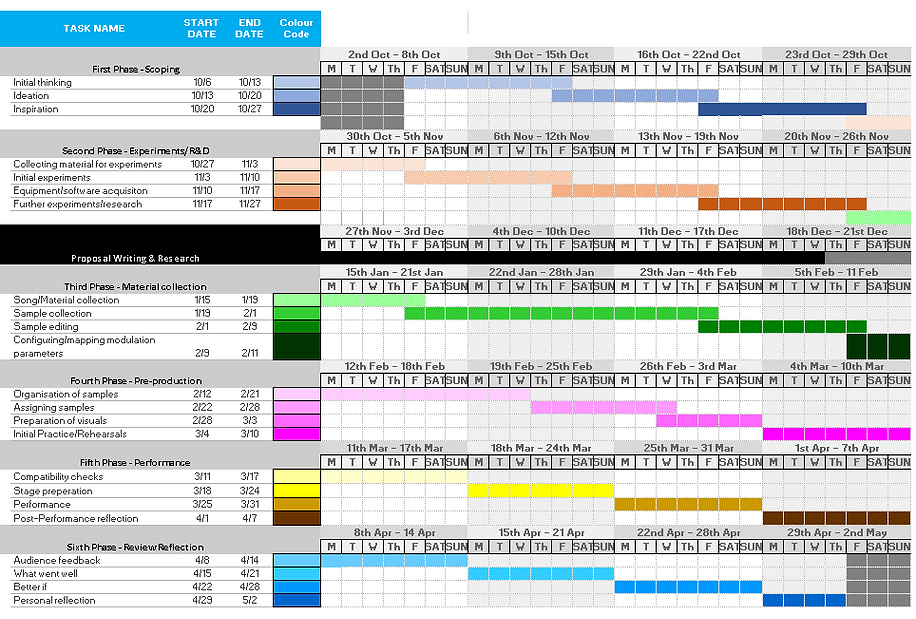
Timeline
Bibliography
-
SZA. 2022. "Low." SOS, Top Dawg Entertainment. [Online] Available at: https://www.youtube.com/watch?v=Z-T_O_vl-8Y [Accessed 17 December 2023].
-
Blindfolksvision1. 2018. "GUCCI MANE RECORDING ADLIBS IN STUDIO." [Online] Available at: https://www.youtube.com/watch?v=WaSb_16TcX0 [Accessed 17 December 2023].
-
Mackintosh, K. 2021. Neon Screams: How Drill, Trap and Bashment Made Music New Again. Repeater Books.
-
Migos. 2017. "Culture." [Online] Genius.com. Quality Control & 300 Entertainment. Available at: https://genius.com/albums/Migos/Culture [Accessed 17 December 2023].
-
Migos (Ft. Lil Uzi Vert) 2016, 'Bad and Boujee', [Online] Genius.com. Available at: https://genius.com/Migos-bad-and-boujee-lyrics [Accessed 20 December 2023].
-
Playboi Carti. 2020. "Stop Breathing." [Online] Genius.com. Interscope Records. Available at: https://genius.com/Playboi-carti-stop-breathing-lyrics [Accessed 17 December 2023].
-
Future & Young Thug. 2017. "Super Slimey." [Online] Genius.com. YSL/Freebandz. Available at: https://genius.com/albums/Future-and-young-thug/Super-slimey [Accessed 17 December 2023].